https://www.oed.com/view/Entry/220636?rskey=QKP9Z6&result=1#eid16017367
to use up
1. transitive.
Thesaurus »
a. To consume or deplete (a stock or supply of something); to exhaust (a resource or reserve).
1712 Bibliotheca Anatomica II. 356/2 When it was all us'd up, they fasten'd another to its End.
1766 L. Carter Diary 20 Aug. (1965) I. 326 The quantity of butter weighed in 4 pots..is 167½ pounds—48 pounds. Weight of the pots leaves 119½ pounds—21 pounds used up in peck butter makes 140½.
1797 J. Woodforde Diary 4 Mar. (1931) V. 16 She is only to take the Pills she has by her & use up the present Bottle of Embrocation.
1811 Ld. Brougham in J. Bentham Wks. (1843) X. 462 I cannot possibly better use up (as the housewives say) this little credit.
1847 Illustr. London News 10 July 27/3 To see if there were anything there that had not yet been used up.
1895 Argosy Sept. 529/1 We may have to use up all our cartridges on him.
1933 R. L. Sutton Arctic Safari 43 I think that we did not use up more than three packs of film.
1976 Conservation of Resources (Chem. Soc.) 20 So far we have used up some 16% of total possible recoverable oil reserves, and only about 4% in the case of coal.
2000 D. Adebayo My Once upon Time (2001) x. 239 Do they let Barber continue and use up his complement of ten overs or..save his barrage for the dread task of the finish?
2008 Independent 18 Apr. 17/5 Organic LEDs that use up less electricity because they don't have to be backlit.
(Hide quotations)
Thesaurus »
†b. In passive (of troops, etc.) to be expended; to be killed or severely disabled so as to be able to take no further part in a conflict. Obsolete.
1785 F. Grose Classical Dict. Vulgar Tongue Used up, killed; a military saying, originating from a message sent by the late general Guise, on the expedition to Carthagena, where he desired the commander in chief, to order him up some more grenadiers, for those he had were all used up.
1809 J. Bristed Hints on National Bankruptcy Brit. iii. vii. 466 A total of two millions eight hundred and fifty thousand men used up in warfare alone, independent of the civil massacres of the revolution, in the course of nineteen years.
1875 C. Merivale Gen. Hist. Rome li. 406 The genuine Roman race must have been almost used up in the desperate warfare.
(Hide quotations)
Thesaurus »
Categories »
c. colloquial (chiefly U.S.). To kill.
1833 J. Hall Legends of West 38 It's a mercy, Miss, that the cowardly varments hadn't used you up body-aciously.
1840 Daily Picayune (New Orleans) 9 Aug. 2/4 Henry McCann, found used up on the levee.
1863 in Southern Hist. Soc. Papers (1884) XII. 220 If you advance..on them in front while I attack them in flank I think we can use them up.
1877 Scribner's Monthly Nov. 41/1 We'll use them up like the pilgrim fathers did the British on Bunker Hill that fourth of July.
1900 H. Garland Eagle's Heart 64 I used up Clint Slocum because I had to.
1937 D. Runyon in Collier's 16 Jan. 9/4 Nicely-Nicely's life is insured for five thousand dollars..if he gets used up by accident.
1994 G. C. Rhea Battle of Wilderness i. 35 Using up Lee, however, was going to take a lot more than simple numbers.
ἀναγνώρισις
anagnṓrisis
Anagnorisis often is paired with peripeteia, which is the unexpected reversal, or shift, of circumstances or a situation. Anagnorisis can lead to either beneficial or tragic results and change the direction of the work. However, anagnorisis mostly leads to tragic results. In a work, the moment of anagnorisis typically occurs within a single line of text. This line of tragic recognition is when the character admits the realization.
anagnorisis differs from epiphany because anagnorisis typically is used in the plot of a tragedy
Aristotle divided tragedy into five acts. The first act introduces the protagonist and shows him or her in a positive state or a position of power or fame. The problem is introduced in the second act and reaches the breaking point by the third act. During the fourth act, the protagonist fails to avoid disaster caused by the problem. The fifth and final act depicts the consequences of the problem and introduces catharsis. Catharsis is the releasing of emotions.
Anagnorisis and peripeteia together enhance the plot. The two often occur simultaneously, as the character makes the realization, which then sparks the reversal of fortune. This sends the character spiraling into tragic demise.
A tragedy is a type of play in which the protagonist experiences a downfall or a series of misfortunes throughout the mythos, or plot, of the work. The character goes from a high to a low. The low is caused by hamartia, or error, typically by the protagonist. Tragedy uses pity and fear to evoke a reaction.
Notes:
Due to limitations of HTML character sets, two substitutions have been required in the crytograms provided above. In place of an inverted paragraph symbol, a capital thorn (Þ) has been used. In place of an inverted dagger, a perpendicular symbol (⊥) has been used. For the cryptogram using inverted letters, it has been necessary to reproduce it as an image.
Poe wrote a letter to Bolton on November 18, 1841, acknowledging that Bolton had indeed managed to solve Dr. Frailey's cryptograph. Poe also attempted to dissuade Bolton from attempting to solve the cryptographs given here, claiming, “It is unnecessary to trouble yourself with the cipher printed in our Dec. number — it is insoluble for the reason that it is merely type in pi or something near it. Being absent from the office for a short time, I did not see a proof and the compositors have made a complete medley. It has not even a remote resemblance to the MS.” There is a difficulty, however, with Poe's claim that the type was so ill-set as to prevent understanding. Indeed, the first cryptograph has been solved, and the solver has noted only seven minor errors, plus three additional errors introduced by J. A. Harrison in his Complete Works of Edgar Allan Poe, 1902. (As Harrison's text is far easier to find than the original issue of Graham's Magazine, these additional errors have been carelessly repeated by numerous other commentators. Both cryptographs are here reprinted from Graham's, the only difference being that a space has been added between each character to improve readability.) In 1991, Terence Whalen recognized that the individual words were correctly sequenced, but their individual characters printed backwards (so that “the” appears as “eht”). (This solution was part of Whalen's 1991 dissertation, but was not published until it appeared in his article “The Code For Gold: Edgar Allan Poe and Cryptography,” Representations, Spring 1994.) In 1993, the cryptograph was independently solved by John Hodgson (“Decoding Poe? Poe, W. B. Tyler, and Cryptography,” Journal of English and Germanic Philology, vol. 92, October 1993, pp. 523-534), who also discovered the source of the quoted text, a few lines from the final act of Joseph Addison's play “Cato”:
“The soul secure in her existence smiles at the drawn dagger and defies its point. The stars shall fade away, the sun himself grow dim with age and nature sink in years, but hou shalt flourish in immortal youth, unhurt amid the war of elements, the wreck of matter and the crush of worlds.”
Using the solution noted by Whalen and Hodgson, the cryptograph should appear as:
, † § : ‡] [ ,? ‡) , [ ¡ ¶? , † ,) ¡ , § [ ¶ Þ , [ ,: ¶! [ . § ( , † § ¡ || (? ⊥? , * * ( ⊥ ⊥ ¡ ( [ , ¶ * . ⊥ [ § ¶ § ¡ . ¶] ¿ , † § [ ? ( § [ : : ( † [ . ⊥ ( *; ( || ( , † § ¡ ‡ [ * : , [! ¶ † || ] ? * ! ¶ ⊥ † § ¶ || , . ( ⊥ ¡ ( , ? ‡ § ( ¡ ☜ ¡ ¶ [ ¡ ¶ [ ? ( , ; § ‡ ☞ ‡] † § §: ( † [ † [ ¶? ‡]: * ¡ ¶: ( § ? ] ! ! ¶ † § ‡ ] ; § ? ‡ † ¡ ‡ ⊥ ¶! ( , † §? ( || * ] [ § ¡ ’ ! , : , , † § ☜ ) , ? || *]? , § § (! ⊥ ¡ ( , † § † [ ‡ ? ) * ] [ ⊥ : ? ] ||
It is certainly possible, of course, that the errors to which Poe refers in his letter are primarily in the second crytograph, which initially remained unsolved.]
In 1999, Whalen published Edgar Allan Poe and the Masses: The Political Economy of Literature in Antebellum America (Princeton: Princeton University Press, 1999). In this fascinating book, Whalen reprints his earlier essay and expands his commentary on the cryptograph, synthesizing additional material from several sources. One of the more intriguing ideas discussed is the possibility that W. B. Tyler might be Poe himself. This possibility was first noted by Shawn Rosenheim (“‘The King of the Secret Readers’: Edgar Poe, Cryptography and the Origins of the Detective Story,” ELH, vol 56, Summer 1989, pp. 375-400, reprinted and revised in The Cryptographic Imagination: Secret Writing from Poe to the Internet, Baltimore: The Johns Hopkins University Press, 1997, pp. 19-41) and Louis Renza in Walter B. Michaels and Donald E. Pease, eds., “Poe's Secret Autobiography,” The American Renaissance Reconsidered: Selected Papers From the English Institute, 1982-1983, Baltimore: Johns Hopkins University Press, 1985). The argument is by no means conclusive, based primarily on the fact that modern researchers have been unable to find a specific person named W. B. Tyler, and that Tyler's letter contains echoes of many of Poe's own sentiments concerning cryptography.
The second crytograph has also been deciphered, by Gil Broza, a software engineer then living in Toronto. In 1998, www.bokler.com announced a contest to solve the puzzle. On October 18, 2000, it announced the winner. Broza's translation is as follows:
“It was early spring, warm and sultry glowed the afternoon. The very breezes seemed to share the delicious langour of universal nature, are laden the various and mingled perfumes of the rose and the –essaerne (?), the woodbine and its wildflower. They slowly wafted their fragrant offering to the open window where sat the lovers. The ardent sun shoot fell upon her blushing face and its gentle beauty was more like the creation of romance or the fair inspiration of a dream than the actual reality on earth. Tenderly her lover gazed upon her as the clusterous ringlets were edged (?) by amorous and sportive zephyrs and when he perceived (?) the rude intrusion of the sunlight he sprang to draw the curtain but softly she stayed him. ‘No, no, dear Charles,’ she softly said, ‘much rather you’ld I have a little sun than no air at all.’ “
The direct source for this text has not been located, but a brief entry in the Sporting Review, a monthly magazine published in London has been identified. In the issue for September 1840, in a section of miscellaneous material called “Monthly Memorabilia,” appears the following item:
“ROMANTIC. — It was a warm but delightful day. The beautiful Helen was seated at an open widow. The impassioned sun shone full upon her face, whilethe amorous zephyrs wantonly played among her cluttering ringlets. Charles Augustus, her devoted and favourite lover, gallantly offered to close the blinds. ‘No, no, dear Charles,’ she languishingly responded, “I’d rather have a little sun than no air at all.”
The point of the item, of course, is the combined puns on “sun/son” and “air/heir.” Although details in the two texts differ enough that one is not, apparently, the direct source of the other, the similarities (including the name of “Charles,” the word “zephrs,” and the final sentence, intact) establish the context for the source. Clearly, this popular joke was making the rounds of the press at the time. The same item was copied in the Baltimore Sun, July 4, 1840 (p. 4), apparently from the Boston Post.
For indeed strange things shall happen, and many secret things be known, and many centuries shall pass away, ere these memorials be seen of men. And, when seen, there will be some to disbelieve, and some to doubt, and yet a few who will find much to ponder upon in the characters here graven with a stylus of iron.
x
↹
⇄
⇠
⇡
⇢
∎ end of proof
≝ EQUAL TO BY DEFINITION
⁜
⁞
𝄖
⁕
Pecuniary motives induced the first printers (from the large sums which were usually paid for manuscripts)
to sell their works as such; so that printing was, for a period, as much the counterfeit as the substitute for writing, it being a fac-simile of the most approved Scribes. p. 9, Typographia
——❃——
The following text is under erasure.
L.A. Necker Esq. (1832) LXI. Observations on some remarkable optical phænomena seen in Switzerland; and on an optical phænomenon which occurs on viewing a figure of a crystal or geometrical solid, The London, Edinburgh, and Dublin Philosophical Magazine and Journal of Science, 1:5, 329-337, DOI: 10.1080/14786443208647909
? ? ? ? ?
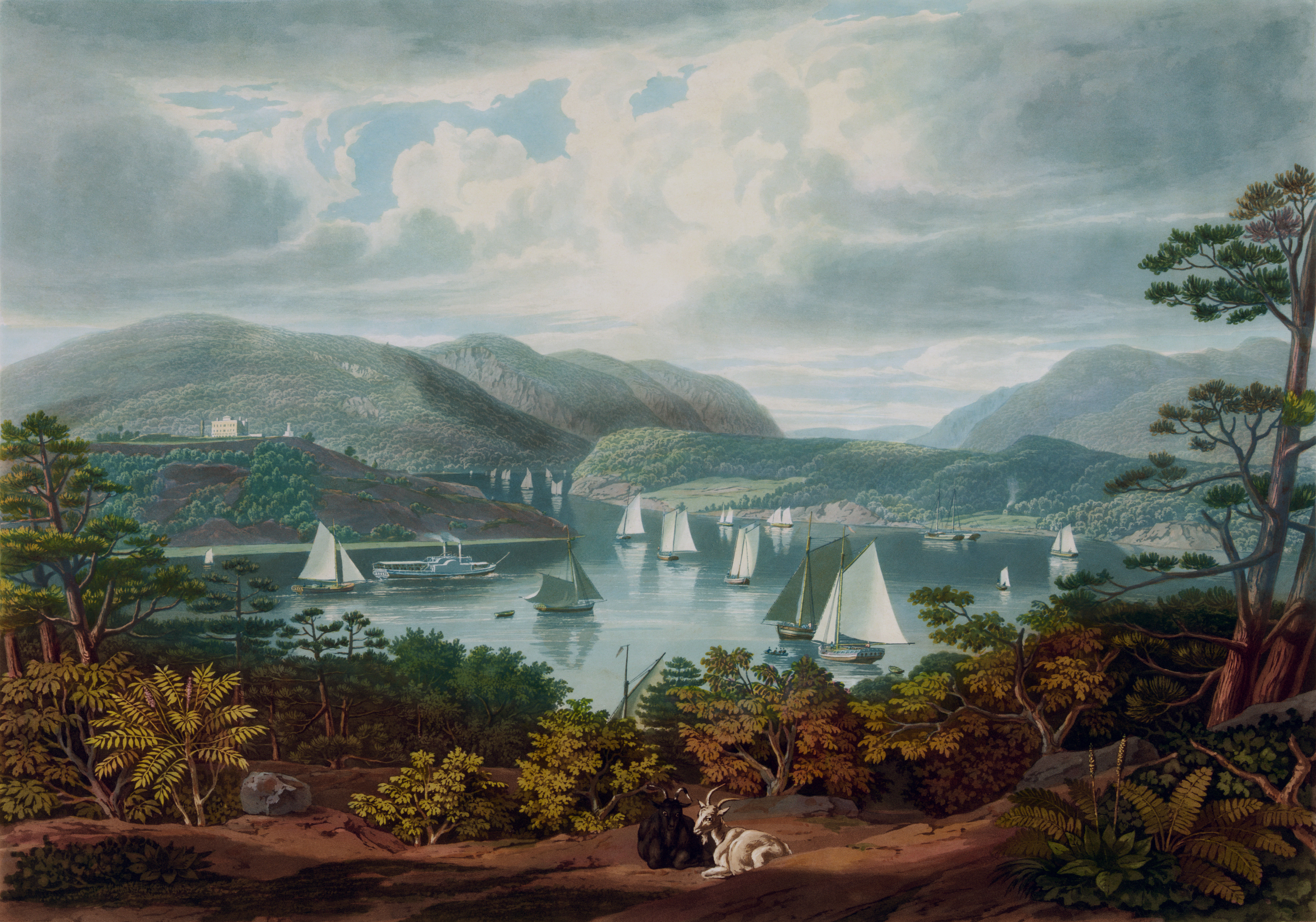
West Point, from Phillipstown. Color aquatint showing the original buildings of the United States Military Academy, with boats on Hudson River, two goats on hill in foreground, mountains in background. Printed by J. & G. Neale, copyright by Parker & Clover, 1831. From the collection of the Library of Congress, Prints and Photographs Division Washington, D.C. Reproduction Number: LC-DIG-pga-00209 (digital file from original print) LC-USZC4-5659 (color film copy transparency) LC-USZ62-12209 (b&w film copy neg.) LC-USZC4-501 (color film copy transparency) LC-USZC2-1875 (color film copy slide) Call Number: PGA – Bennett–West Point, from Phillipstown (D size) [P&P]
Marginalia 247
I have sometimes amused myself by endeavoring to fancy what would be the fate of any individual gifted, or rather accursed, with an intellect very far superior to that of his race. Of course, he would be conscious of his superiority; nor could he (if otherwise constituted as man is) help manifesting his consciousness. Thus he would make himself enemies at all points. And since his opinions and speculations would widely differ from those of all mankind — that he would be considered a madman, is evident. How horribly painful such a condition! Hell could invent no greater torture than that of being charged with abnormal weakness on account of being abnormally strong.
In like manner, nothing can be clearer than that a very generous spirit — truly feeling what all merely profess — must inevitably find itself misconceived in every direction — its motives misinterpreted. Just as extremeness of intelligence would be thought fatuity, so excess of chivalry could not fail of being looked upon as meanness in its last degree: — and so on with other virtues. This subject is a painful one indeed. That individuals have so soared above the plane of their race, is scarcely to be questioned; but, in looking back through history for traces of their existence, we should pass over all biographies of “the good and the great,” while we search carefully the slight records of wretches who died in prison, in Bedlam, or upon the gallows.
INSTALLMENT XV
Southern Literary Messenger — test test test In like manner, nothing can be clearer than that a very generous spirit — truly feeling what all merely profess — must inevitably find itself misconceived in every direction — its motives misinterpreted. Just as extremeness of intelligence would be thought fatuity, so excess of chivalry could not fail of being looked upon as meanness in its last degree: — and so on with other virtues. This subject is a painful one indeed. That individuals have so soared above the plane of their race, is scarcely to be questioned; but, in looking back through history for traces of their existence, we should pass over all biographies of “the good and the great,” while we search carefully the slight records of wretches who died in prison, in Bedlam, or upon the gallows.
June 1849 XV, 336-38
MARGINALIA.
By Edgar A. Poe.
[34 items, no. 223-256]
A message from the late Carl R. DeLand
Welcome to DeLand, FLA!
♻
⌒
Philosophy, in the guise of talking Truth, spins the Universe into being out of language.
IMPRESSION. A “case of the first impression" is one without a precedent; one presenting a wholly new state of facts; one involving a question never before determined.
IMPRIMATUR. Lat. Let it be printed. A license or allowance. granted by the constituted authorities, giving permission to print and publish a book. This allowance was formerly necessary, in England, before any book could lawfully be printed, and in some other countries is still required.
Imprimis: [Abbreviated form Imp: or Impris] Latin for “In the first place” usually at the start of a list of bequests in a Will
the cartoon Poe
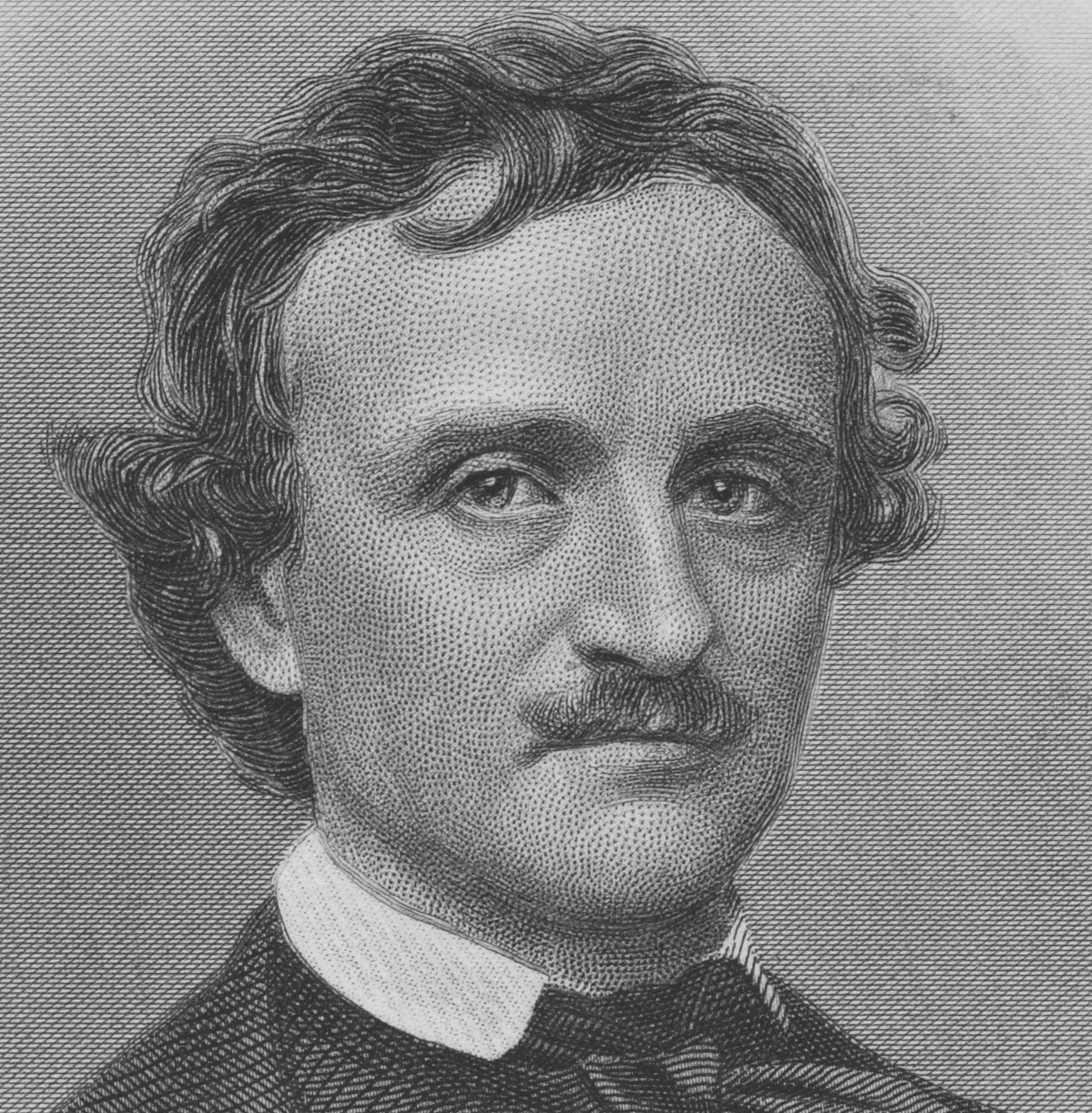
 that we know today? Compare to the steelpoint on the home page: surely he is laughing at us, the sneer barely repressed. The man knows something. He is hiding something from us. He knows that we know that he knows, and he loves knowing that. He is a diddler.
———
https://videos.criticalcommons.org/media/encoded/16/sammondn/c8d2e26d5dc14765975cf1ac7fcffc2a_3VHKylf.mp4
Criticalcommons.org.
How does a scholar differ from a scholar-squirrel? The squirrel is a careerist who mindlessly gathers little facts for professional reasons. I don’t in the least mind this sort of welfare for the “educated” middle class. They must live, too. But when they start working in concert to revise history to suit new political necessities, I reach for my ancient Winchester…
There is no reason why Current, master of our language though he is, should understand how a novel — even one that incorporates actual events and dialogue — is made. The historian-scholar, of course, plays god. He has his footnotes, his citations, his press clippings, his fellow scholar-squirrels to quote from. If he lacks literary talent, he then simply serves up the agreed-upon facts as if they were the Truth, and should he have a political slant — and any American schoolteacher is bound to, and most predictable it is — the result will emerge as a plaster saint, like that dead effigy of Jefferson by Dumas Malone and his legion of graduate students.
Although a novel can be told as if the author is God, often a novel is told from the point of view of one or more characters. For those of us inclined to the Jamesian stricture, a given scene ought to be observed by a single character, who can only know what he knows, which is often less than the reader. For someone with no special knowledge of — or as yet interest in — Grant, the fact that harnesses and other leather goods were sold along with saddles by the failure Grant is a matter of no interest. The true scholar-squirrel, of course, must itemize everything sold in the shop. This is the real difference between a novel and a biography. But though I tend in these books more to history than to the invented, I am still obliged to dramatize my story through someone’s consciousness. But when it comes to a great mysterious figure like Lincoln, I do not enter his mind. I only show him as those around him saw him at specific times. This rules out hindsight, which is all that a historian, by definition, has; and which people in real life, or in its imitation the novel, can never have.
What is Mabbott corresponding with Houdini about? Why is this stamped “Register or Insure: Valuable Mail”?
https://www.magictricks.com/houdini-envelope-mabbott.html
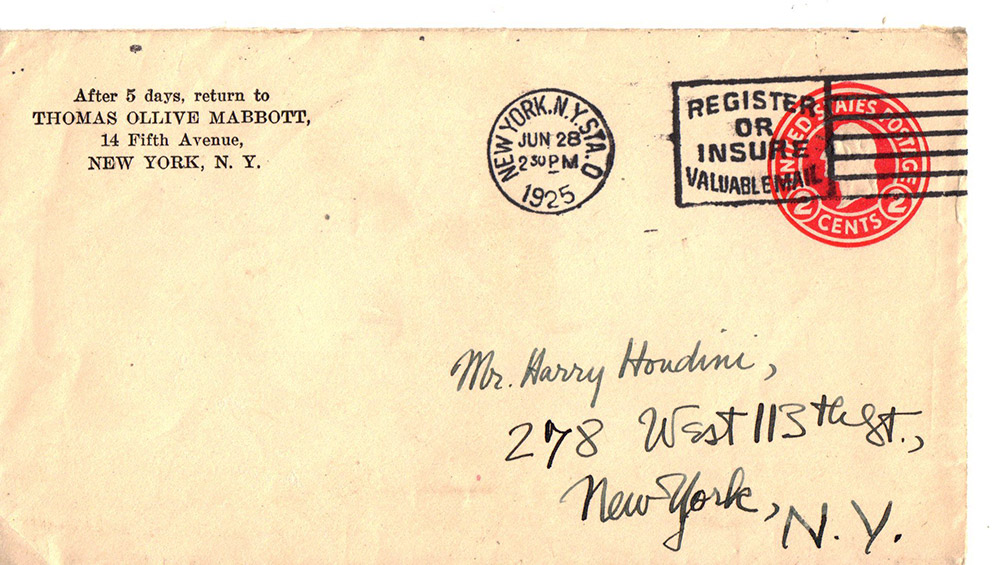
Envelope of presumed letter, T. O. Mabbott to Harry Houdini, June 28, 2:30 PM, 1925.
https://www.eapoe.org/papers/misc1921/hre38pam.htm
“In conclusion it is an interesting fact to note that the late Harry Houdini, the famous conjurer, was the proud possessor of the portable writing desk which belonged to Edgar Allan Poe, upon which the great apostle of mystery wrote some of his finest creations. Mrs. Houdini now has this highly prized relic.”
Henry Ridgely Evans, “Edgar Allan Poe and Magic,” Linking Ring (Bluffton, OH), vol. XVIII, no. 7, September 1938, pp. 413-416
Delete this text and replace it with your own slide content.
You can place almost any kind of content into a slide, including text, tables, snippets, images, multimedia, and more.
☛xx
☞xx
☜xx
☯ xx
✒
∵ because
|
|
|
Anti wormholes are interesting theoretical toys, because it’s not immediately obvious why (other than the "bphysics conjecture", Visser 1996) they should be any less likely to exist than "conventional" wormholes. We can even imagine a variant on the toroidal universe (section 18.3) with "normal" and "reversing" routes between any two points. But in this case, the definition of which arm is "really" normal and which is "really" reversing becomes purely arbitrary, and we can no longer say definitively whether a given particle should "really" be counted as an electron or as a positron — the definition is roule-dependent. We can still create useful Iocal labels for whether a particle is positively or negatively charged (when compared side-by-side with a local reference charge), but we lose global definitions of charge and polarity. This sort of hypothetical universe is referred to as an Alice Universe, and electrical charge in such a universe is called Cheshire Charge, after Alice and the Cheshire Cat in Lewis Carroll's "Alice" books. |
Anti wormholes are interesting theoretical toys, because it’s not immediately obvious why (other than the "bphysics conjecture", Visser 1996) they should be any less likely to exist than "conventional" wormholes. We can even imagine a variant on the toroidal universe (section 18.3) with "normal" and "reversing" routes between any two points. But in this case, the definition of which arm is "really" normal and which is "really" reversing becomes purely arbitrary, and we can no longer say definitively whether a given particle should "really" be counted as an electron or as a positron — the definition is roule-dependent. We can still create useful Iocal labels for whether a particle is positively or negatively charged (when compared side-by-side with a local reference charge), but we lose global definitions of charge and polarity. This sort of hypothetical universe is referred to as an Alice Universe, and electrical charge in such a universe is called Cheshire Charge, after Alice and the Cheshire Cat in Lewis Carroll's "Alice" books. |
Web
Ontology comes from the Greek “ontos,” which means being, and “logos,” meaning study. It is the study of being.
Epistemology
This word comes from the Greek “episteme,” which means knowledge, and “logos,” meaning study.
Poe is working at the intersection of ontos and episteme, which normally one does not think of, much less attempt in fiction. He sees a common origin = = final result within a throbbing organism, not a cold logos. [It is and isn’t what we think of as logos today.] The organism exists for a microsecond at this intersection, which is mimicked by the reading act in the middle of a hoax, at the moment of realization, when the thaumatrope whirls and another image is revealed. It is of course, hard to sustain, and that is hardly the attempt, after all. Poe is after the quick flash of recognition, the hair-raising moment of oh my God he didn’t! when the reader gets the hoax and begins to unravel it, then re-assemble the layers and reinterpret the surface story for hidden doublespeak.
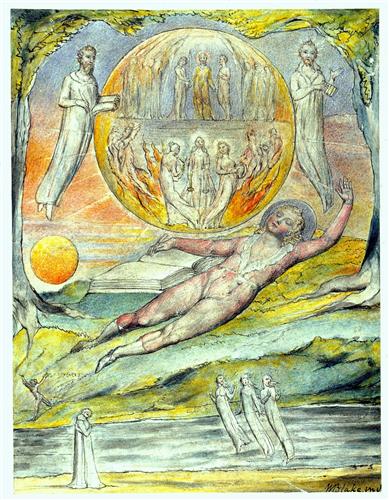
Poe assumes that the shimmering orb (imagine something out of Blake t is at the origin of both ontos and episteme. The post-Modernists assume that this origin is only a myth at best; a hollow shell of a thought (and Thought is essentially meaningless). This is a warm spot, the same spot that is replicated when inked hot type hits paper. [why didn’t Foucault play with this?] It is the spot/the moment at which meaning lives and simultaneously dies in the hoax, throttled by its own creator for our cruel amusement. To Poe, Thought may or may not be meaningless, and reaching back to the origin of being to explain knowledge (– or is it vice versa? like “Hans Phaall,” it’s all relative) is the way into the investigation. There is not a Nothingness at the center of it all, but whatever It is is ineffable and that is the impetus for an infinite quest – until death, of course.
William Blake, The Youthful Poet`s Dream, 1816-1820.)
The hoax always involves a cracking open of fiction, that is, of popular fiction of the 1830s on the surface and a deep stab at Aristotle underneath. The seams are ripped open to show the tent traders of rag books that is the literati-establishment of Poe’s day. [cartoon: Men puffing pipes log roll rags.] To Poe, they are all quacks, mere sophists while he is a seeker of truth. Some of them have figured out how to profit handsomely.
Alice universes1Click Me!
Anti wormholes are interesting theoretical toys, because it’s not immediately obvious why (other than the "boring physics conjecture", Visser 1996) they should be any less likely to exist than "conventional" wormholes. We can even imagine a variant on the toroidal universe (section 18.3) with "normal" and "reversing" routes between any two points. But in this case, the definition of which arm is "really" normal and which is "really" reversing becomes purely arbitrary, and we can no longer say definitively whether a given particle should "really" be counted as an electron or as a positron — the definition is roule-dependent. We can still create useful Iocal labels for whether a particle is positively or negatively charged (when compared side-by-side with a local reference charge), but we lose global definitions of charge and polarity. This sort of hypothetical universe is referred to as an Alice Universe, and electrical charge in such a universe is called Cheshire Charge, after Alice and the Cheshire Cat in Lewis Carroll's "Alice" books.
We don't normally take the possibility of anti wormholes very seriously, because the universe would have to be more complicated to allow them, and because they don’t seem to solve any existing problems. Trying to be more scientific, we can say that since a "true” Klein bottle requires four embedding-space dimensions rather than three, a universe containing anti wormholes probably requires an embedding-space with one dimension more than a universe that only allows "conventional" wormholes, and we can then use Occam's Razor to argue that it would be bad practice to add extra dimensions to the universe just to allow anti wormholes to exist, when nothing else in physics seems to need them.
Baird, Eric, Relativity in Curved Spacetime: Life without Special Relativity. UK: Chocolate Tree Books, 2007: 259.
In mathematics, a function is a binary relation between two sets that associates every element of the first set to exactly one element of the second set. Typical examples are functions from integers to integers, or from the real numbers to real numbers.
Functions were originally the idealization of how a varying quantity depends on another quantity. For example, the position of a planet is a function of time. Historically, the concept was elaborated with the infinitesimal calculus at the end of the 17th century, and, until the 19th century, the functions that were considered were differentiable (that is, they had a high degree of regularity). The concept of a function was formalized at the end of the 19th century in terms of set theory, and this greatly enlarged the domains of application of the concept.
A function is a process or a relation that associates each element x of a set X, the domain of the function, to a single element y of another set Y (possibly the same set), the codomain of the function. It is customarily denoted by letters such as f, g and h
If the function is called f, this relation is denoted by y = f (x) (which reads "f of x"), where the element x is the argument or input of the function, and y is the value of the function, the output, or the image of x by f. The symbol that is used for representing the input is the variable of the function (e.g., f is a function of the variable x).
Wikipedia
but if
y = f (x)
and
x = f (y)
we have merely defined a tautology; nothing can move.
Anti wormholes are interesting theoretical toys, because it’s not immediately obvious why (other than the "boring physics conjecture", Visser 1996) they should be any less likely to exist than "conventional" wormholes. We can even imagine a variant on the toroidal universe (section 18.3) with "normal" and "reversing" routes between any two points. But in this case, the definition of which arm is "really" normal and which is "really" reversing becomes purely arbitrary, and we can no longer say definitively whether a given particle should "really" be counted as an electron or as a positron — the definition is roule-dependent. We can still create useful Iocal labels for whether a particle is positively or negatively charged (when compared side-by-side with a local reference charge), but we lose global definitions of charge and polarity. This sort of hypothetical universe is referred to as an Alice Universe, and electrical charge in such a universe is called Cheshire Charge, after Alice and the Cheshire Cat in Lewis Carroll's "Alice" books.
⁇
⁈
⁉
| Mind | soul | Body |
| ※ | ||
| Fiction | reading |
We don't normally take the possibility of anti wormholes very seriously, because the universe would have to be more complicated to allow them, and because they don’t seem to solve any existing problems. Trying to be more scientific, we can say that since a "true” Klein bottle requires four embedding-space dimensions rather than three, a universe containing anti wormholes probably requires an embedding-space with one dimension more than a universe that only allows "conventional" wormholes, and we can then use Occam's Razor to argue that it would be bad practice to add extra dimensions to the universe just to allow anti wormholes to exist, when nothing else in physics seems to need them.
Baird, Eric, Relativity in Curved Spacetime: Life without Special Relativity. UK: Chocolate Tree Books, 2007: 259.
Anti wormholes are interesting theoretical toys, because it’s not immediately obvious why (other than the "boring physics conjecture", Visser 1996) they should be any less likely to exist than "conventional" wormholes. We can even imagine a variant on the toroidal universe (section 18.3) with "normal" and "reversing" routes between any two points. But in this case, the definition of which arm is "really" normal and which is "really" reversing becomes purely arbitrary, and we can no longer say definitively whether a given particle should "really" be counted as an electron or as a positron — the definition is roule-dependent. We can still create useful Iocal labels for whether a particle is positively or negatively charged (when compared side-by-side with a local reference charge), but we lose global definitions of charge and polarity. This sort of hypothetical universe is referred to as an Alice Universe, and electrical charge in such a universe is called Cheshire Charge, after Alice and the Cheshire Cat in Lewis Carroll's "Alice" books.
We don't normally take the possibility of anti wormholes very seriously, because the universe would have to be more complicated to allow them, and because they don’t seem to solve any existing problems. Trying to be more scientific, we can say that since a "true” Klein bottle requires four embedding-space dimensions rather than three, a universe containing anti wormholes probably requires an embedding-space with one dimension more than a universe that only allows "conventional" wormholes, and we can then use Occam's Razor to argue that it would be bad practice to add extra dimensions to the universe just to allow anti wormholes to exist, when nothing else in physics seems to need them.
Baird, Eric, Relativity in Curved Spacetime: Life without Special Relativity. UK: Chocolate Tree Books, 2007: 259.
--
The feeling of the sublime, so far as it arises from a contemplation of the distance of the stars, of their greatness and physical extent, reflects itself in the feeling of the infinite, which belongs to another sphere of ideas included in the domain of mind. - Kosmos, p. 40
a cacophonous market exists inside the bookseller’s stall, where 18th and 19th century texts mingle with classic reprints. Poe mimics this in Hans’s “desultory reading” [fn link to bookmark at quote on poe, with cf. ]
Yet another Frog-pondian bites the dust:
“The main part of Poe’s ‘Hans Pfaall’ is a serious, perhaps even partly plausible, account of a trip to the moon. In this account Poe wrote with great care ...”2 declares Edmund Reiss of Harvard University. The sciency-sounding letter is undercut by the jocular framework. In sum, “[h]ere, in fact, Poe cleverly but actually tells his readers that ‘The Unparalleled Adventure of One Hans Pfaall’ is nothing but an April Fool's joke.”3
But Poe merely lifted his descriptions from existing text, our equivalent of “cutting and pasting” in a word processor. The main part of “Phaall” is the joke on the reader.
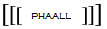
[[[ phaall ]]]
∞
When Hans says
For a few minutes I remained wrapped in the profoundest meditation. I have a distinct recollection of frequently compressing my lips, putting my forefinger to the side of my nose, and making use of other gesticulations and grimaces common to men who, at ease in their arm-chairs, meditate upon matters of intricacy or importance.
he is describing the reading act. Further, the “matters of intricacy or importance” are exactly the tale you are ingesting.
Herschel has two entries in the 82d volume Hans mentions:
I. On the ring of Saturn, and the rotation of the fifth satellite upon its axis, Phil. Trans. R. Soc. 1792.82:1-22
II. Miscellaneous observations, Phil. Trans. R. Soc. 1792.82:23-27
Pirated British ed. 1838:
It will be seen by a note at the end of the volume, that Mr. Pym’s sudden death (of which we have no particulars) occurred while these sheets were passing through the press; and that the narrative consequently breaks off abruptly in its most important part. But the exciting interest of the story, and the intrinsic evidence of its truth and general accuracy, induce us to give it to the public as it is, without further comment.
The Publishers.
67, Paternoster-row, London, Oct., 1838.
Poe is getting tricky here:
When you read, “That Hans Phaall himself, the drunken villain, and the three very idle gentlemen styled his creditors, were all seen...”, do you see only Hans and the three creditors, or do you see a fourth as well: “the drunken villain”? I suggest a likely pun here, with the narrator standing in as the drunken villain. I don’t think Poe would cast himself that way, but I am comfortable that he would plant an avatar.
Determines that Poe thinks “A truly secret language would have to be unfamiliar to the point of being unrecognizable, meaning that whatever discernible traces of its existence we might encounter, we would almost certainly mistake them for something else.” Mieszkowski, Jan. “Unreadable Pleasures.” J19: The Journal of Nineteenth-Century Americanists, 7:1 (Spring 2019): 10.
Let Animals of this groveling Nature, who, formed meerly of Clay, without one animating Spark to lift them above the Sphere of common Attraction, drudge upon their Mother Earth; let them fneer at, or condemn, what they cannot underftand, while we, difdaining, like Alexander, to own ourfelves pent within the penurious Limits of one World, range thro’ the whole Planetary Syftem : Let Men of Titles and Fortune, without Heads, purfue one fafhionable Tract, while we afpire to Climes, Speculations, and Curiofities beyond their Reach. - Sir Humphrey Lunatic addresses his critic
The table of contents for the 82d volume is available here: https://royalsocietypublishing.org/toc/rstl/1792/82
Although Herschel has two entries, neither mentions occultations regarding Jupiter. However, Mr. Schroeter, of Lilienthal has this: link to PDF
Secret Writing
Nonsensical phrases and unmeaning combinations of words, as the learned lexicographer would have confessed himself, when hidden under cryptographic ciphers, serve to perplex the curious enquirer, and baffle penetration more completely than would the most profound apothems of learned philosophers.
--
-
Observations
-
Conclusions
-
Explanations
---
- [T]he College of Astronomers in the city of Rotterdam — as well as all other colleges in all other parts of the world — not to mention Colleges and Astronomers in general — are, to say the least of the matter, not a whit better, nor greater, nor wiser than they ought to be.
- Hans Phaall himself, the drunken villain, and the three very idle gentlemen styled his creditors, were all seen, no longer than two or three days ago, in the tippling house in the suburbs, having just returned, with money in their pockets, from a trip beyond the sea.
- [T]he newspapers which were stuck all over the little balloon were newspapers of Holland, and therefore could not have been made in the moon.
- [A]n odd little dwarf and bottle conjurer, both of whose ears, for some misdemeanor, have been cut off close to his head, has been missing for several days from the neighboring city of Bruges.
- [C]ertain wags in Rotterdam have certain especial antipathies to certain burgomasters and astronomers.
Does this dis-prove or un-prove the theorem?
By reversing the observations with the explanation, we see what Poe is trying to prove: professors don’t Get It. The reason why is that “certain wags” are out to get them. Resolution is the only operation necessary to solve any problem in the class.
Simple sentences express simple facts about the world. Compound sentences express logical relationships between the simpler sentences of which they are composed.
Α = capital letter alpha Α
Ω = capital omega Ω
∅ = empty set ∅
Hints
Photocopy of pages 2393-2394 from The Macmillan Book of Proverbs, Maxims, and Familiar Phrases, ed. Burton Stevenson (New York: The Macmillan Company, 1948). The proverb of interest is: "Truth lies at the bottom of a well," attributed to Heraclitus as well as Democritus and others. In "Murders in the Rue Morgue" Dupin implicitly responds to the proverb when he says: "Truth is not always in a well."
Gooder, R. D. “Edgar Allan Poe: The Meaning of Style.” The Cambridge Quarterly, 16.2 (1987): 110-123.
.. we have a penchant for riddles ourselves. In spite of the anathemas of the over-wise, we regard a good enigma as a good thing. Their solution affords one of the best possible exercises of the analytical faculties, besides calling into play many other powers. We know of no truer test of general capacity than is to be found in the guessing of such puzzles.
...
“Why is a bad wife better than a good one? — Because bad is the best.” This somewhat ungallant old query, with its horrible answer, is an embodiment of the true genius of the whole race to which it belongs — the race of the conundrums. Bad is the best. There is nothing better settled in the minds of people who know any thing at all, than the plain truth that if a conundrum is decent it wo'nt do — that if it is fit for anything it is not worth twopence — in a word that its real value is in exact proportion to the extent of its demerit, and that it is only positively good when it is outrageously and scandalously absurd.
— Alexander's Weekly Messenger, vol. 3, no. 50, December 18, 1839, p. 4.
Poe has been, notoriously, an embarrassment to American literature. Along with Mark Twain he has been the most popular of all American writers both at home and abroad, and thanks to the interest that the French have taken in him, his influence has reached further than that of any other American writer. The French literature on Poe is enormous, and he has been admired by other writers as various as Dostoevski, Swinburne, G. B. Shaw, Lawrence, Eliot and Auden. Americans, however, have found Poe childish, or unhealthy, or both, and with one or two distinguished exceptions (William Carlos Williams, Allen Tate) have left him to the schoolrooms and to the academies. Poe has been thought to be, on the whole, insufficiently American, and rather unnatural. His solipsistic characters do nothing — except occasionally solve a puzzle — that Americans find admirable, they have no recognizable context, and they establish no relation to ordinary life. Yet, if we stand back from these things, we shall see that they are the very qualities which set Poe’s writing close to the centre of American literature. (110)
|
The French literature on Poe |
Americans find |
|---|---|
|
text |
text |
|
Poe has been, notoriously, an embarrassment to American literature. Along with Mark Twain he has been the most popular of all American writers both at home and abroad, and thanks to the interest that the French have taken in him, |
Poe has been, notoriously, an embarrassment to American literature. Along with Mark Twain he has been the most popular of all American writers both at home and abroad, and thanks to the interest that the French have taken in him, |
|
text |
text |